Technical
What AI Manga Translation Can and Cannot Do: Real Capability Boundaries
Updated 2026-07-28
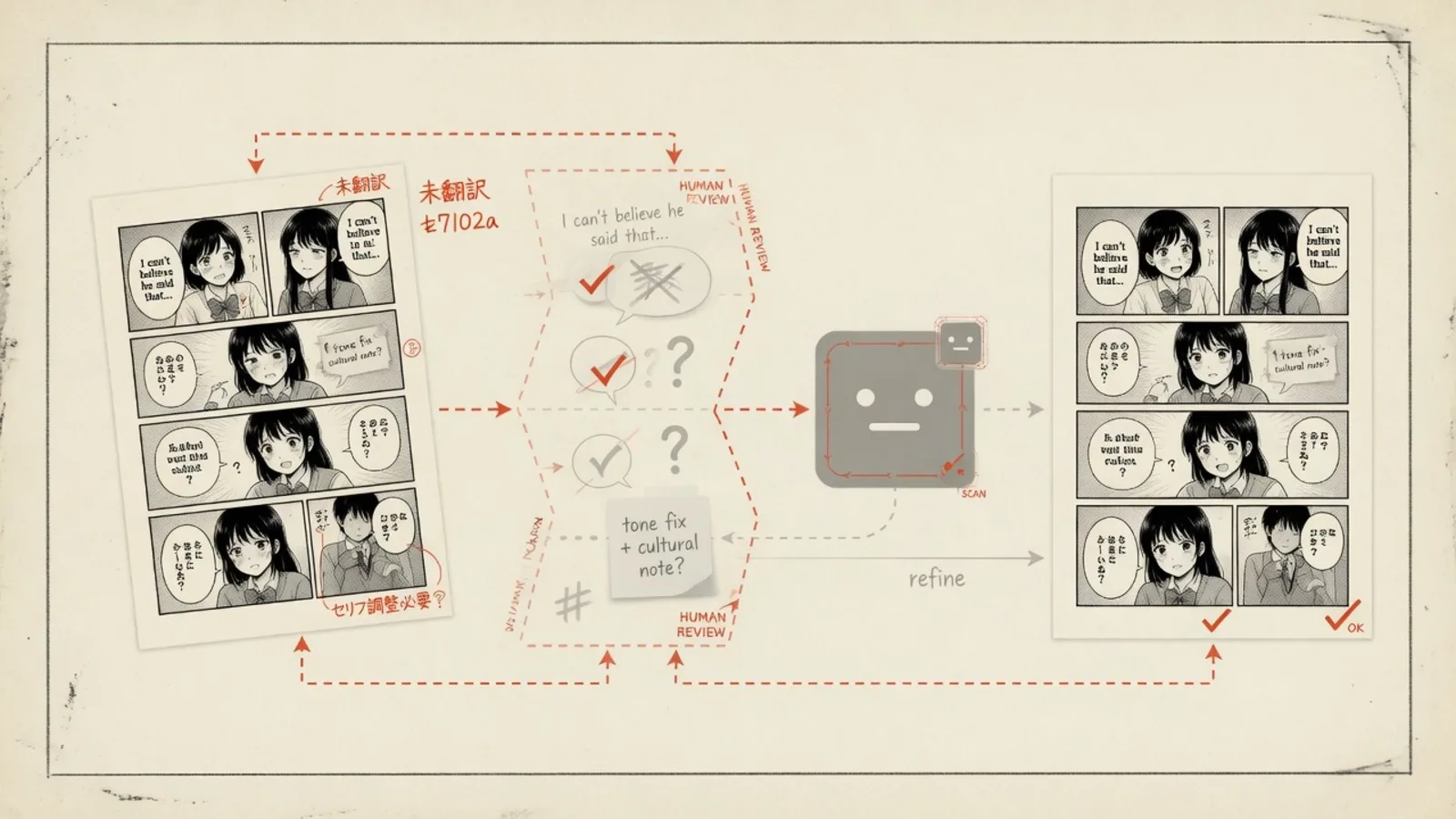
An evidence-based look at where AI already drafts well for manga—and where OCR, culture, SFX, and lettering still need human judgment.
A friend asked me last year: "Is AI manga translation actually reliable now? Can I just throw raw manga in and get something readable out?"
My answer: yes and no.
Yes—if you mean "can I understand what's happening?" Then sure, AI is good enough for that. No—if you mean "can I publish this?" Then sorry, we're nowhere close.
This isn't fence-sitting. It's the most honest answer the current state of AI manga translation allows. And the line between "yes" and "no"—exactly where it falls—is the most under-discussed and most important question in this space.
This article draws from a dedicated deep research report on AI manga translation capability boundaries. If you're using a tool like AI Manga Translator or considering bringing AI into your manga translation workflow, this is worth your time.
First, Let's Clear Something Up: Manga Translation Is Not "Translation"
This is the biggest misconception in the entire conversation. People assume manga translation = converting Japanese dialogue to English (or another target language). Wrong.
The real pipeline is a five-stage relay race, and any leg can drop the baton:
- Text detection & OCR—find where the text is, then actually recognize the characters
- Reading comprehension—figure out who's speaking, in what order, and how this line connects to the previous panel
- Translation—convert source language to target language
- Typesetting & redrawing—erase the original text, fit the translation into the bubble with correct font size, line breaks, and positioning
- Review—catch flipped subjects, misidentified names, lost puns, broken consistency
Five stages. If one fails, the final output the reader sees is compromised. And yet, most discussions of AI manga translation fixate exclusively on stage three.
A 2025 study published at COLING did the legwork: GPT-4 Turbo with page-level visual understanding (PBP-VIS) achieved strong automatic scores on Japanese-to-English manga translation, with xCOMET hitting 0.776—significantly better than text-only methods. But when professional manga translators did a human quality review (MQM), the system produced 160 "critical" errors, compared to 107 from the official human translation. In other words: the machine sounds smoother on average, but it still blows key details—and readers often won't notice the errors when they happen.
And that's what makes it dangerous: not that the translation sounds clunky, but that it sounds correct while being wrong.
The Real Bottleneck Is Often Not Translation—It's OCR
Here's a fact you might find surprising: the weakest link in AI manga translation right now is often not the machine translation engine—it's the text recognition that comes before it.
A 2026 study on manga OCR (MangaOCR / MangaLMM) delivered a wake-up call. Researchers threw leading multimodal models—Llama-3.2-90B-Vision, Pixtral-12B, GPT-4o, Gemini 1.5 Pro—at the task of precisely reading text in manga panels. Their combined scores? All essentially zero. Meanwhile, MangaLMM, fine-tuned specifically on manga data, scored 71.5.
From zero to 71.5. That gap tells you everything: text in manga is not the same thing as text in a scene photo or a scanned document. Manga text has characteristics that break generic OCR:
- Sound effects split into fragments scattered across the artwork
- Hand-drawn lettering with no standard font
- Text that curves, distorts in perspective, or is partially occluded
- Tiny narration text outside speech bubbles, often overlooked
- Reading order that isn't simple left-to-right or top-to-bottom
So the next time an AI translation of a manga panel feels inexplicably awful, don't immediately blame the translation model. There's a good chance the OCR stage already got it wrong. Even the best MT engine can only translate the text it was given—and if that text is garbled, garbage in, garbage out.
Where AI Is Already Good Enough
Let's be fair—after all those caveats, AI manga translation has made real, meaningful progress. Here are the scenarios where it's reached "go ahead and use it" territory:
1. Reading Assistance / Understanding Raw Manga
This is AI manga translation's most solid use case. If you just want to read manga that hasn't been officially translated yet—clear printed text, standard fonts, no wild layout gymnastics—page-level multimodal translation can already produce a reliable draft. Tools like AI Manga Translator are explicitly positioned for this: helping readers quickly understand content that lacks professional translation, not replacing professional scanlation.
2. Informational Text
Narration captions, place names, menus, street signs, newspaper headlines—these are far easier than character dialogue. They don't depend on character voice, don't require narrative coherence, and don't contain puns or wordplay. Data from the CanMT cultural translation benchmark confirms this: geographic and ecological terms see noticeably higher accuracy than abstract linguistic symbols.
3. Short Dialogue with In-Page Disambiguation
When a line is short, emotional intent is straightforward, and the visual cues within the same page can resolve "who's speaking" and "what's being referred to," AI performance is already solid. Research shows page-level visual methods lift automatic scores for Japanese-to-English manga translation from 0.758 (text-only) to 0.776—visual context demonstrably disambiguates.
But there's a crucial caveat: more context is not always better. Multiple studies converge on the same finding: expanding context beyond a single page actually degrades translation quality. The sweet spot is "current page plus the immediately adjacent scene"—not an ever-growing context window.
Where Humans Are Still Non-Negotiable
1. Puns, Cultural References, and Idioms
This is AI manga translation's hardest boundary, and there's no breakthrough on the horizon.
Models aren't entirely clueless—they often "know there's a joke here"—but they can't consistently produce an expression that works in the target culture without altering the narrative. The CanMT research describes this as a "knowledge-application gap": a persistent disconnect between a model's cultural knowledge and its ability to produce a usable translation. Abstract linguistic symbols (allusions, puns, sarcasm) are the hardest category in cultural translation.
Manga comedy, roast-style humor, and character catchphrases overwhelmingly fall into this bucket. Translating a Chinese idiom literally as "without medicine" when it means "hopeless beyond remedy," or rendering "my father" as "my mother"—these are errors the reader may not immediately catch, but the character dynamics and emotional tone are quietly being rewritten.
2. Sound Effects, Hand-Drawn Text, and Unconventional Layouts
The trouble here starts at the recognition stage. The COO dataset was purpose-built for manga sound effect annotation precisely because generic OCR assumes text sits in neat horizontal blocks—while manga SFX are frequently fragmented, curved, spanning multiple objects, or even crossing panel boundaries. The latest version of the Manga109 dataset explicitly notes that dialogue/SFX annotation overlaps and undersegmented speech bubbles can mislead modern AI's understanding of page structure.
If recognition is wrong, no translation engine can save it. And even when recognition is correct, sound effect translation strategy is complex—do you transliterate ("ドカン" → "DOKAN"), localize the sound ("BOOM"), or preserve the original Japanese with a note? That decision depends on the artwork, emotional tone, and reading rhythm of each panel. AI is nowhere near making this kind of contextual judgment.
3. Commercial Publication and Official Release
This is the bottom line. Not because "AI isn't good enough" in a vague sense, but because the current public evidence does not support fully automated publishing.
Lippmann et al.'s study already demonstrated that even the best automated method (PBP-VIS) produces significantly more critical errors than human translation. Literary translation research repeatedly finds that large language model outputs are inherently more literal, less stylistically varied, and "thinner in voice" than human translations—and manga dialogue demands exceptionally strong "voice." The open-source tooling community knows this too: mainstream manga translation tools explicitly recommend in their documentation that machine-translated releases should be labeled as such if not reviewed by an experienced translator.
Under U.S. copyright law (17 U.S.C. § 101 et seq.), unauthorized translations of copyrighted works constitute derivative works that infringe the original creator's exclusive rights. Even AI-assisted translations require proper licensing for commercial distribution. The Berne Convention for the Protection of Literary and Artistic Works, to which the United States is a signatory, similarly protects translation rights as part of an author's exclusive rights under Article 8.
Hybrid Workflows: The Most Realistic Approach Right Now
After all this talk of "can" and "can't," the most practical question remains: what's the smartest way to use AI?
The answer is a hybrid workflow. Not picking the strongest model and hoping it handles everything, but breaking the system into an auditable, correctable pipeline with clear human touchpoints.
A recommended flow looks like this:
Page Input → Text Detection & Region Segmentation → Manga-Specific OCR
→ Reading Order & Scene Context Extraction → Translation Generation
→ Glossary & Style Rule Correction → Multimodal QA → Automated Typesetting
→ Human Post-Editing → Pre-Release Spot Check
Three steps here are the most frequently overlooked—and the most critical:
- Reading Order & Scene Context Extraction: determines whether you correctly understand who is speaking, in what order, and how each panel relates to the last
- Glossary & Style Rule Correction: determines whether character names, honorifics, and catchphrases stay consistent across an entire volume
- Multimodal QA: catches the insidious errors that "look correct but quietly rewrite the story"
A few concrete engineering recommendations:
-
Separate OCR from translation. Don't hand OCR entirely to a black-box multimodal model. Keep a reviewable, human-correctable text layer. Manga text recognition is not a minor patch on top of generic OCR.
-
Build character cards, glossaries, and style guides. For names, organizations, honorific tiers, catchphrases, and fixed expressions, a glossary is more effective than swapping in a bigger model. Both DeepL and Google Cloud Translation support glossaries—use these structured assets.
-
Use structured output instead of free text. Have the model output fields like
speaker,source_text,translation,register,must_keep_terms,sfx_policy,confidence, andneeds_human_review—not just a raw translated string. This lets reviewers and QA precisely locate the source of issues. -
Use multimodal models for correction, not for everything. Run OCR extraction first, then let a vision model check: "Is this name a character name or a common noun?" "Who is this dropped subject more likely referring to?"—a corrector-style usage is more stable than end-to-end black-box.
-
Tier your risk. Categorize pages into three levels: low-risk (glossary + missing text check only), medium-risk (focus on character relationships and voice), high-risk (thorough review of puns, SFX, and full-page layout). Put human time where it matters most.
The Bottom Line: A Grounded, Useful Position
If I had to summarize the state of AI manga translation in a single sentence, here it is:
AI can now reliably handle "understanding" and "drafting"—but it remains a significant distance from replacing professional manga translators and letterers.
This isn't equivocation. It's a conclusion verified by multiple academic papers from 2023–2026, real-world feedback from open-source tooling, and professional translator quality evaluations.
For any team aiming for publishable quality, the right strategy isn't "full automation." It's: use AI to eliminate as much mechanical labor as possible, and concentrate human effort on the places where AI is most likely to fail—and where failure is most expensive.
In other words, AI isn't the endgame tool that replaces human translators. It's the upstream efficiency tool that rewrites the manga translation production chain. Get that framing right, and your expectations for AI manga translation won't be too high or too low—they'll be exactly right.
This article is based on publicly available research from 2023–2026, including COLING 2025 manga translation studies, the MangaOCR/MangaLMM benchmark, the MMTIT-Bench text-image translation evaluation, and the CanMT cultural translation benchmark, among other open sources.