Education
The 5 Most Common Manga Translation Mistakes—and Why Even AI Gets Them Wrong
Updated 2026-07-30
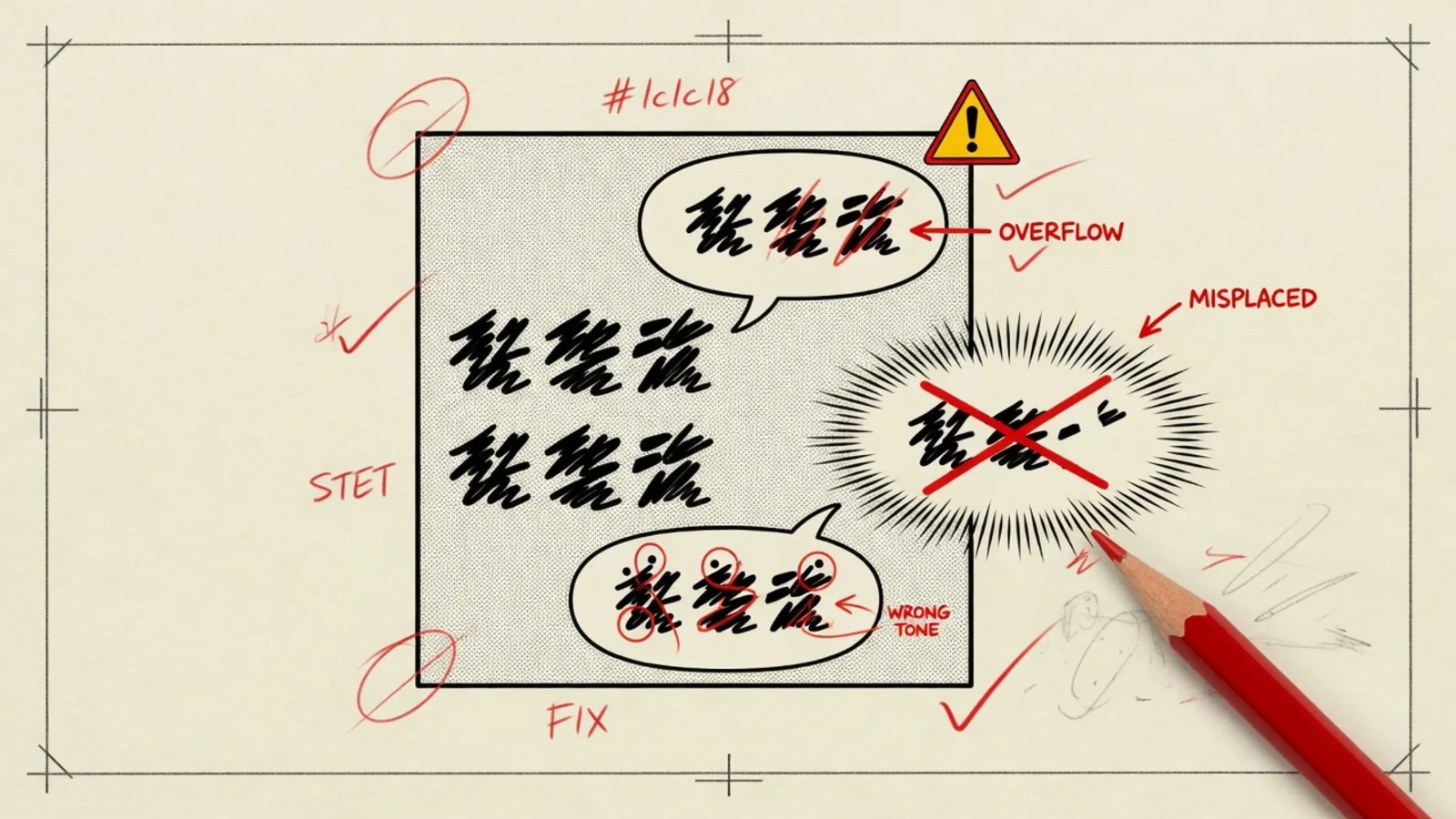
Onomatopoeia, character voice, honorifics, bubble geometry, and visual gags—the failure modes that break both human and AI manga translation.
You know that feeling when you're reading a scanlated manga chapter and something feels off? The dialogue flows fine. The typesetting is clean. But the characters feel flatter than they should, the jokes don't quite land, and certain scenes miss the emotional weight you sensed in the original.
You're not being picky. You're noticing what happens when manga translation treats "getting the words right" as the finish line. The real challenge is transferring character voice, visual rhythm, humor mechanics, and atmospheric tension all at once. That's a multi-modal problem, not a sentence-level one.
The Japan Foundation's materials on manga onomatopoeia make a sharp observation: sound effects in manga communicate stillness versus motion, strength versus weakness, through font size, stroke weight, and placement on the page. Manga scholar Natsume Fusanosuke goes further—hand-drawn SFX in Japanese comics function as both word and image, woven into the narrative flow. (See the Japan Foundation's Japanese-Language Education resources)
In other words: manga translation isn't about converting Japanese sentences into English ones. It's about transferring information layered across words, character voice, bubble geometry, negative space, and reading rhythm into a different language. Lose any one of those layers, and the reading experience frays.
Below are the five places where that fraying happens most. This article draws on a systematic research report covering high-risk manga translation scenarios, pulling from academic papers, industry practice, and reproducible test cases.
Scenario 1: Onomatopoeia and Mimetic Words—It's Not Just "Sound," It's Atmosphere
Japanese manga's onomatopoeia and mimetic words (giongo and gitaigo) are denser and more functionally loaded than their English counterparts. They don't just imitate sounds—じーっ (jii-) conveys staring intently, しーん (shiin) communicates awkward silence that fills the room, ぞわっ (zowa') evokes chills running down your spine.
The problem? Many translation pipelines—especially text-only AI systems—handle these words in one of three ways: skip them entirely, romanize them as is (Shiin...), or flatten them into emotionally vacant equivalents ("quiet").
Here's a textbook case:
| Item | Content |
|---|---|
| Original | しーん…… |
| Common Mistake | Shiin…… / (omitted entirely) / "Quiet……" |
| Recommended | Dead silence…… or keep the original SFX with a small margin note |
Why is "quiet" wrong? Because this isn't about the dictionary definition of silence. It's about the awkward, tension-filled stillness that follows a joke that bombed or a moment that landed wrong. Translating it into a generic adverb—or worse, deleting it—drains the panel of its dramatic weight.
The academic literature backs this up. Inose's research on onomatopoeia translation strategies identifies nine distinct approaches and concludes that, barring genuinely redundant cases, omission is rarely the ideal choice. Rohan et al.'s eye-tracking experiments found that approaches preserving the visual punch of SFX captured reader attention better than purely explanatory footnotes.
Three practical rules: First, determine whether the SFX represents a sound or a state—don't mechanically treat every SFX as a noise word. Second, don't flatten everything into "-ly" adverbs (quietly, suddenly). Third, when the target language lacks a direct equivalent, prioritize an explanatory phrase or combination expression over deletion.
Scenario 2: Honorifics and Speech Patterns—Every Character Should Sound Different
Japanese has an entire system of yakuwarigo—fictionalized speech patterns that immediately evoke specific character archetypes in the reader's mind. ~でござる signals a samurai type. ~っス signals a sporty junior. ~わよ signals a refined young lady. Hokkaido University's KAKEN research project explicitly identifies yakuwarigo and giongo/gitaigo as key challenges in Japanese-Chinese manga translation.
This is exactly where AI translation tends to "standardize" everything into the same neutral register.
| Item | Content |
|---|---|
| Original | 了解っス、先輩! |
| Common Mistake | "Understood, senior!" |
| Recommended | In a sports club context: "Got it, senpai!" or "You got it, boss!" |
That little っス ending isn't just "I understand." It packs four layers of information into three characters: junior status + casual speech + light respect + youthful energy. AI's most common failure mode is compressing all of that into a flat, characterless sentence anyone could say.
Osaka University's research on Chinese translations of NARUTO is blunt: if translators don't continuously track a character's linguistic fingerprint, the character's personality fails to transfer across languages. One reason is that Chinese simply has a less granular set of linguistic resources for evoking specific character types than Japanese. But the bigger reason is that translators often don't treat speech quirks and sentence endings as persistent variables that need maintenance across pages and volumes.
The practical fix: build a character language sheet. At minimum, track each major character's first-person pronoun (ore? boku? watashi?), their address terms for others (-san? -kun? -senpai?), their signature sentence endings, and their verbal tics. Check the sheet every time that character speaks. This isn't academic idealism—NMT research has already shown that politeness level can be improved through explicit control tags.
Scenario 3: Cultural References—The Question Isn't "Keep or Replace," It's "How Do You Make It Understood?"
Setsubun means throwing beans to drive out demons. School trips go to Kyoto. On Valentine's Day, girls give chocolate to boys. These references are as natural in manga as prom or Thanksgiving are in American media—but whether they feel natural to the target reader depends entirely on how you handle them.
Cultural references trip up translators in two classic ways: either everything is preserved verbatim and readers are left confused, or everything is aggressively localized and the work stops feeling like it came from Japan.
| Item | Content |
|---|---|
| Original | 今日って節分だろ? 豆まきしないの? |
| Common Mistake | "Today's Setsubun, right? Aren't we going to throw beans?" |
| Recommended | General audience: "It's Setsubun—the bean-throwing festival—today, isn't it? Aren't we going to drive out the demons?" |
Chow's research on Malay-language manga translations reveals a clear trend: editions from the 1990s–2010s frequently used replacement and deletion, while by 2021, translations increasingly adopted transliteration retention with explanatory additions to stay closer to the source culture. Today's readers are increasingly comfortable with Japanese cultural presence—what they reject is things that make no sense with nobody explaining why.
A working principle: first, ask what function this reference serves in the panel (plot advancement? character building? humor? worldbuilding?), then decide how to handle it. Plot-critical references should prioritize comprehensibility. Cultural-flavor references, when reader tolerance is high, can be retained with light explanation. Visual anchors already visible in the artwork (if the panel literally shows someone throwing beans, you can't describe it as putting up Christmas decorations) should never conflict with what's drawn on the page.
Scenario 4: Speech Bubble Layout—You Translated It Right, but Nobody Can Read It
This is the pitfall that non-practitioners almost never see coming. You produce a semantically flawless translation. You place it back into the speech bubble. And one of three things happens: the bubble is half-empty (dramatic weight evaporates), the text is crammed to the edges (unreadable), or the translation covers the character's face (pointless).
Manga translation doesn't end when the text is translated. It continues through bubble/text layer processing, font selection, positioning, resizing, and line-breaking. Professional letterers and graphic editors place the translation back into the bubble, adjusting scaling, movement, and even bubble expansion or text compression based on the shape and its relationship to the artwork.
The Japanese-to-English direction makes this especially visible: many Japanese bubbles are designed for vertical text and the sprawling length of keigo, while English often conveys similar meaning in fewer characters. The result isn't "shorter is better"—it's that an underfilled bubble deflates the dramatic center of gravity.
| Item | Content |
|---|---|
| Original | 本当にありがとうございます……! |
| Common Mistake | "Thank you!" |
| Recommended | "I really… can't thank you enough!" |
The problem with "Thank you!" isn't just that it's short. 本当に (really), ございます (humble-polite form), and the trailing …… (pause/emotion) all signal gratitude layered with formality and emotional weight. AI compresses all of it. The human version expands slightly, restoring the compressed politeness, pauses, and emotional signals—giving you something that sounds more like the character and fills the bubble more naturally.
Here's what it looks like in a simulated tall vertical bubble:
Original layout          AI short output          Adapted output
 (tall vertical)         (bubble wasted)          (bubble filled)
 Re                      T                        I
 al                      h                        r
 ly                      a                        e
 …                       n                        a
 th                      k                        l
 an
 k                       y                        c
 s                       o                        a
 (h                      u                        n
 um                      !                        '
 ble
 -p                                               t
 ol
 it
 e)
 …                                                …
 !                                                 !
Golden rule for bubble adaptation: prioritize pragmatic expansion first (restore politeness, emotion, pauses, terms of address), then typographic correction (adjust font size and line spacing), and only as a last resort stretch the text artificially. Translation and typesetting are not independent stages—they need at least one round of back-and-forth revision.
Scenario 5: Puns and Dad Jokes—The Words Are Right, the Laugh Is Gone
This is the scenario where "word-for-word accuracy" is the most dangerous metric.
Results from the CLEF/JOKER automated pun translation task are sobering: system outputs skewed heavily literal, with roughly 60% of examples failing to reconstruct the pun in the target language. JOSTrans' research on English-Chinese pun translation identifies the core strategies: preserve the pun, separate and explain, shift the imagery, sacrifice secondary information, and use editorial intervention.
| Item | Content |
|---|---|
| Original | 布団が吹っ飛んだ! |
| Common Mistake | "The futon flew away!" |
| Recommended | "My futon got blown away—get it? Fu-ton? I'll see myself out." |
The original relies on the near-homophony of 布団 (futon) and 吹っ飛んだ (futtonda, "got blown away") to create a deliberately terrible pun. English can't replicate this one-to-one, but it can preserve the "intentionally lame" function. If the character is delivering this as a dad joke on stage, the translation must signal to readers that yes, this is a groaner—not a neutral statement of fact.
The core philosophy for pun translation: prioritize function, then form. If you can reconstruct an equivalently terrible pun in English, go "pun-for-pun." If you can't, consider "weak pun + self-aware acknowledgment of its lameness" to preserve character function. If the pun is tightly bound to plot and can't be altered, use "natural body text + light footnote explaining the original mechanism." And for AI-generated candidates: never settle for one. Generate at least three and pick the best manually—single-shot literal translation almost always fails.
AI vs. Human Translators: Who Should Do What?
By this point you might be thinking: "So should I use AI translation or wait for a human scanlation group?"
The answer isn't one or the other. It's division of labor.
Here's a table grounded in existing research on manga translation, literary translation, and machine translation—not an abstract "better/worse" comparison, but a practical workflow judgment:
| Problem Type | What AI Does Well | Where AI Stumbles | What Humans Do Well | Best Work Split |
|---|---|---|---|---|
| Onomatopoeia / Mimetic Words | Batch identification, fast draft generation | OCR misses curved text; romanizes or deletes; doesn't understand visual-dramatic function | Sees "sound, state, image, rhythm" together; decides between full replacement or original-with-note | AI handles detection + first draft; human makes visual decisions |
| Honorifics / Speech Patterns | Can be more stable than raw translation with character cards | Standardizes—makes everyone sound the same | Maintains long-term character differentiation; knows when to stay consistent and when to break pattern | AI draft only with explicit style settings; formal publication needs human consistency editing |
| Cultural References | Fast cultural-item lookup, multi-version candidate generation | Fails both ways: mechanical preservation or excessive localization | Decides "keep, swap, annotate, relocate" based on work positioning and visual anchors | AI generates candidates and risk flags; human decides final strategy |
| Bubble Layout | Auto-detect text regions, estimate line count, produce draft typesetting | Optimizes for "fitting text in," producing gaps, crowding, occlusion, or reading-order chaos | Balances semantics, character voice, and visual aesthetics | AI does draft layout; human does final typesetting and micro-adjustment |
| Puns / Dad Jokes | Multi-candidate generation; works as "pun candidate pool" | Tends toward literal translation; ~60% fail to reconstruct the pun | Judges whether to preserve "the laugh" or "the information" | AI for brainstorming only; final output strongly recommends human rewrite |
The emerging best practice in the industry is increasingly clear: AI handles preprocessing and risk screening; humans handle final decisions and style control. On one hand, platforms like Mantra integrate AI into the manga localization pipeline while explicitly enabling translator/designer real-time editing. On the other hand, some publishers publicly state they translate directly from the source language using professional translators and do not use AI. The industry hasn't converged on "full automation"—because these high-risk points still demand human judgment.
This is also consistent with how data protection regulations like the GDPR approach automated decision-making: under Article 22 of the GDPR, individuals have the right not to be subject to solely automated decisions that produce legal or similarly significant effects. While manga translation doesn't typically trigger this clause, the principle behind it—that creative and context-dependent tasks benefit from meaningful human review—applies. (See GDPR Article 22)
Something You Can Test Right Now: Reproducible Test Cases
Whether you're evaluating translation tools or building your own pipeline, here are five minimal test cases you can run today. The experiment design is simple: run them first in "sentence-level, no-context" mode, then again with "character settings + scene context," and compare.
| Case | Target Issue | Source | Common Failure | Expected Output Direction |
|---|---|---|---|---|
| T1 | Onomatopoeia | しーん…… | Romanization / omission / "Quiet" | Dead silence…… (preserve the "air freezing" tension) |
| T2 | Honorifics / Speech quirks | 了解っス、先輩! | "Understood, senior!" | Got it, senpai! or You got it! (preserve junior status and youthful energy) |
| T3 | Cultural reference | 今日って節分だろ? 豆まきしないの? | Stiff literal translation | It's Setsubun—the bean-throwing festival, isn't it? |
| T4 | Bubble adaptation | 本当にありがとうございます……! | "Thank you!" | I really… can't thank you enough! (preserve politeness, emotion, and bubble fill) |
| T5 | Pun / Dad joke | 布団が吹っ飛んだ! | "The futon flew away!" | My futon got blown away—get it? (signal that it's a deliberate groaner) |
Judge each output on four dimensions: Is the semantics preserved? Is the character relationship preserved? Is the bubble adapted properly? Is the humor/atmosphere preserved? AI can often come close on the first two. The last two are where the gap between machine and human consistently opens up.
The Honest Bottom Line
The most common failure in manga translation isn't "not knowing the words." It's assuming that the information distributed across language, character, artwork, and bubble geometry lives only in the sentences.
A good translation tool needs to recognize that this is manga, not a menu—it has to understand bubbles, vertical text, sound effects, character voice, and reading rhythm. This is where AI Manga Translator earns its place: its "bubble erasure → translation → inpainting → reading-flow preservation" pipeline is one of the cleanest implementations in the consumer space. It doesn't replace human judgment. It positions human judgment at the stage where it has the most information and the highest leverage.
This article is based on a systematic research report on high-risk manga translation scenarios, drawing on materials from the Japan Foundation on onomatopoeia and yakuwarigo, University of Shanghai for Science and Technology research on Japanese onomatopoeia translation into Chinese, Hokkaido University's KAKEN project on Japanese-Chinese manga translation, ACL/AAAI/WMT academic conference papers on manga translation and evaluation, the CLEF/JOKER automated pun translation task, and other publicly available sources. All conclusions represent the author's independent assessment based on publicly available information. For readers in the EU/EEA interested in the intersection of AI and creative translation, see the European Commission's AI Act overview for the regulatory landscape on AI-assisted content production.