Education
Manga Translation vs. Anime Subtitles: Why the Same Line Gets Cut in Half on Screen
Updated 2026-07-29
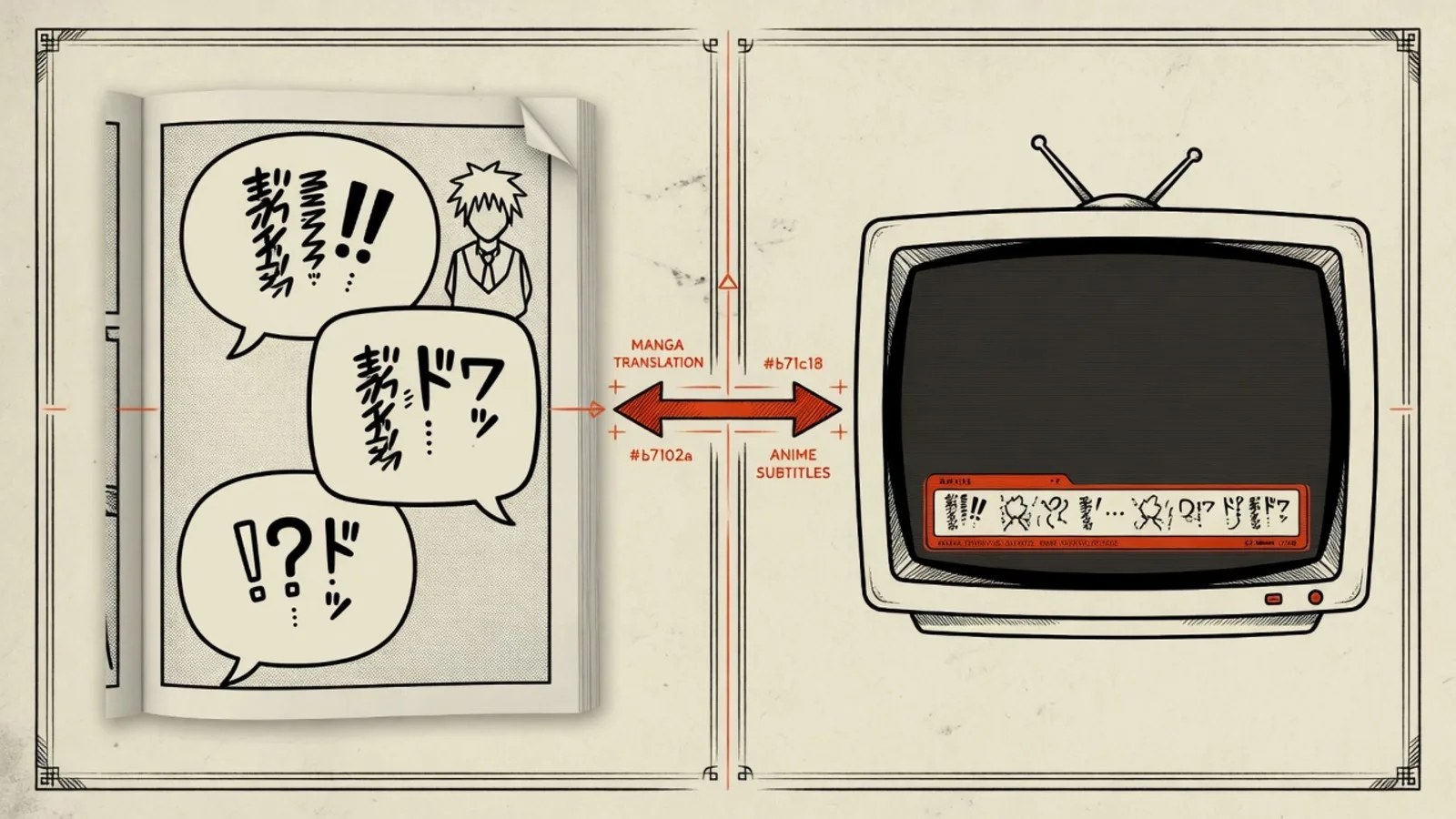
Space, time, and CPS budgets: how manga bubbles and anime subtitles force completely different translation strategies for the same dialogue.
Ever notice this? The manga version of a scene has a character delivering a full, information-dense line. The anime subtitle for the exact same moment is half as long—and sometimes means something slightly different.
It's not lazy translation. It's physics. These two mediums impose fundamentally different constraints on the text, and those constraints dictate entirely different translation strategies.
Both manga translation and anime subtitling are trying to do the same thing: fit information from one language into a container with hard limits. But manga's container is a speech bubble on a static page. Subtitles live in a narrow strip at the bottom of a screen that only sticks around for a few seconds. Different containers, different rules.
The Core Difference: Space vs. Time
If you had to boil it down to one sentence:
Manga translation's primary problem is "how do I fit these words into the artwork?" Subtitle translation's primary problem is "how do I squeeze these words into the time I've got?"
Subtitles are what researchers call "system-paced text." You don't control how long they stay on screen—the timeline does. Netflix's Chinese Simplified Timed Text Style Guide mandates a maximum of 16 characters per line, typically one line (two at most), with a reading speed cap of 9 characters per second for adult programming and 7 CPS for children's content. The UK's Ofcom, in its consultation on subtitle quality, similarly emphasizes that subtitle speed is a primary determinant of viewer comprehension and enjoyment. A subtitle that stays on screen for 2.4 seconds, at 9 CPS, has a theoretical maximum of roughly 21 characters—and that's before accounting for punctuation.
Manga flips the script. Reading time is entirely reader-controlled—you can linger on a single bubble, skip back three panels, or breeze through a page in seconds. The constraint is spatial: bubbles have fixed dimensions (unless you manually resize them), text can't obscure character faces or key action, and reading order must follow the page's visual flow. In practice, English-language lettering guides from practitioners like Evan Waterman suggest keeping bubbles under 20–25 words. For Chinese manga lettering at the industry-standard 6.5–7pt, a medium-sized dialogue bubble comfortably holds roughly 18–24 characters.
In short: subtitles ask "can the viewer finish reading this?" Manga asks "will the reader want to keep going?"
Spatial Constraints: A Narrow Strip vs. a Living Layout
Subtitles occupy a brutally simple space: a strip at the bottom of the screen. China's NRTA specification (GY/T 359—2022) requires subtitles to sit within the bottom safe area, one line per screen with a maximum of two, and mandates that English subtitles not exceed 50 characters per screen. Subtitles must also avoid overlapping with mouths, faces, key action, and on-screen text in the lower third of the frame. Every subtitle is fighting the moving picture for screen real estate.
Manga's spatial constraints are more organic—and more treacherous. A speech bubble isn't a sticker slapped on top of the art. It's part of the composition. Its size, shape, placement, and font all convey tone and narrative rhythm. Academic research on comics localization emphasizes that manga translation isn't just word replacement—it's visual adaptation. Bubbles, caption boxes, on-page text, and sound effects may all need reworking. Japanese manga bubbles are designed for Japanese writing conventions; when translated into languages with longer word lengths, the spatial tension is immediate and real.
Phil Christie's manga lettering guide recommends body text at 6.5–7pt, with line spacing equal to or slightly larger than the font size, and roughly one letter's width of breathing room between text and bubble edge. These aren't publisher-mandated hard rules—they're accumulated trade wisdom from people who've done this thousands of times.
Here's the spatial comparison at a glance:
| Dimension | Manga Translation | Anime Subtitling |
|---|---|---|
| Container | Bubbles, caption boxes, on-page text, SFX | Bottom screen strip |
| Lines | Varies by bubble and composition; 2–4 common | Typically 1 line, max 2 |
| Per-line capacity | Medium bubble: ~6–8 Chinese characters/line | Netflix Simplified Chinese: 16 characters/line |
| Per-container limit | English: ~20–25 words per bubble (trade practice) | Simplified Chinese: typically ≤32 chars/screen |
| Font size | Trade standard: 6.5–7pt | Set to fit target character count without obstruction |
| Layout flexibility | Adjustable kerning, leading, font, bubble size | Limited font/position flexibility |
| Text-image relationship | Text is part of the composition | Text overlays the image |
Temporal Constraints: Formula-Driven vs. Reader-Driven
Subtitle timing can be reduced to a formula:
Available characters = min(line cap × lines, CPS cap × duration in seconds)
Worked example: a Simplified Chinese subtitle stays on screen for 2.5 seconds. At Netflix's adult threshold of 9 CPS, the theoretical max is 2.5 × 9 = 22.5, so roughly 22 characters. But the screen cap is 16 chars/line × 2 lines = 32 characters. The real ceiling is the smaller number: 22 characters. Now try a 4-second subtitle—the CPS cap allows 36 characters, but you hit the 32-character screen limit first.
This is why professional subtitling workflows run in a specific order: get the timecodes → calculate the character budget → write the translation within that budget. Drafting a full sentence and chopping it down afterward is a disaster waiting to happen in subtitling.
Manga has no countdown clock. But it has a different kind of time: the more text on a panel, the longer readers' eyes stay there. Eye-tracking studies confirm that text-heavy panels receive longer dwell times, and higher text-to-image ratios pull visual attention away from the artwork. So manga's temporal pressure isn't "can they read it in time?"—it's "does the page rhythm still flow?"
Cultural Adaptation: Manga Can Add Notes. Subtitles Have to Absorb Everything.
This is the deepest strategic divide between the two mediums.
Manga has a massive advantage: explanatory information can live outside the bubble. Research on official Japanese-to-English and Japanese-to-Malay manga translations shows that translator's notes can be flexibly distributed—inside panels, in the gutter between panels, at the bottom of the page, or in end-of-volume glossaries. They handle onomatopoeia, honorifics, puns, terminology, and cultural references. The reader encounters a foreign element, glances at the note, and moves on without narrative disruption.
Subtitles have no such depth. A 2024 empirical study of English-to-Chinese subtitle corpora found that fansubs frequently use glosses (explanatory on-screen annotations), but official streaming subtitles overwhelmingly favor omission and lexical recreation. The same pattern appears in earlier research on fansubbing communities: translator's notes and glosses are among the most recognizable hallmarks of amateur subtitling—and among the first things professional workflows eliminate. It's not that subtitles can't explain. It's that professional environments won't put explanations on screen, because they directly consume reading time and visual attention.
Here's how three typical challenges play out differently:
| Challenge | Original (Japanese) | Manga Solution | Subtitle Solution |
|---|---|---|---|
| Honorifics | 先輩、これお願いします。 | "Senpai, could you help me with this?" + margin note on first occurrence | "Could you help me with this?" (relationship absorbed into context; honorific dropped) |
| Mimetic word | しーん (awkward silence) | Retain original SFX artwork + small in-panel note: "dead silence" | Usually omitted; if critical, a brief "[silence]" |
| World-building term | ブラックアウト | "Blackout" with a page-margin note explaining it as a recurring phenomenon | "The blackout"—short, consistent, no room for elaboration |
Manga lets readers see the cultural marker and get an explanation. Subtitles demand that readers understand everything in seconds, with no recourse afterward.
Strategy Map: It's Not "Which Is More Faithful"—It's "Which Actually Works"
Translate manga with a subtitler's mindset, and you'll over-compress everything. Chop long dialogue into short bursts. Delete cultural references wholesale. Strip out all the sound effects. The result reads fast, sure—but the work's flavor evaporates along the way.
Translate subtitles with a manga translator's mindset, and you'll overload every line. Cram three sentences into one subtitle, then add a parenthetical explanation. The viewer hasn't finished reading the first line before the shot changes.
The right framework isn't "which translation is more faithful?" It's:
Given this medium's constraints, should this piece of information be preserved, compressed, relocated, explicitly explained, or handed off to the visuals/audio?
Here's a strategy feasibility table across both mediums:
| Strategy | Manga Viability | Subtitle Viability | Notes |
|---|---|---|---|
| Literal translation | Medium | Low–Medium | Risks stiffness and length |
| Paraphrase / free translation | High | High | Readable, may lose nuance |
| Compression / omission | Medium | Very high | The subtitle translator's default tool |
| In-panel / margin / endnotes | Very high | Very low | Manga's unique superpower |
| Sentence restructuring | High | High | Adapts to reading order or timing |
| Retain original SFX + small translation note | Very high | Extremely low | Standard manga practice |
| Full explanation on first occurrence, abbreviation thereafter | High | Medium | Manga has room to "build a glossary" |
Two Pipelines for the AI Era
Once you understand the constraint gap between these two mediums, you can evaluate AI translation tools with clearer eyes.
For manga translation, tools like AI Manga Translator focus on automating the lettering pipeline: detect bubble regions → erase original text → embed translation → maintain typesetting. The value proposition is clear—it frees human translators from hours of Photoshop work. But AI still has limited depth in judging bubble capacity, reading order flow, and the visual impact of sound effects. The final call on "this 'quiet' should really be 'dead silence'" still belongs to a human reviewer.
For subtitle translation, professional subtitling software has long integrated timecodes, CPS calculations, and line-breaking rules into the workflow. AI-assisted subtitling isn't really about translating faster—it's about translating better within a strict character budget. Finding the most impactful 20-character expression of a sentiment is harder than translating with no constraints at all.
The Bottom Line
Manga translation and anime subtitling aren't a competition. They're two approaches to the same problem under radically different physical constraints: giving a reader in another language something close to the original experience.
If you're a reader, the next time you notice the subtitle version and the manga version of the same line differ, you probably won't think "the subtitlers got lazy." You'll think about whether cramming 30 words into 2 seconds was just too much to ask.
If you're a translator—or someone using AI to translate—remember two rules: for manga, plan your bubble splits before you start writing. For subtitles, calculate your CPS budget before you translate a single word. Get the order right, and the results take care of themselves.