Guides
Webtoon, Manhwa & Manhua Translation in 2026: Why Vertical Scroll Breaks Most Tools
Updated 2026-07-29
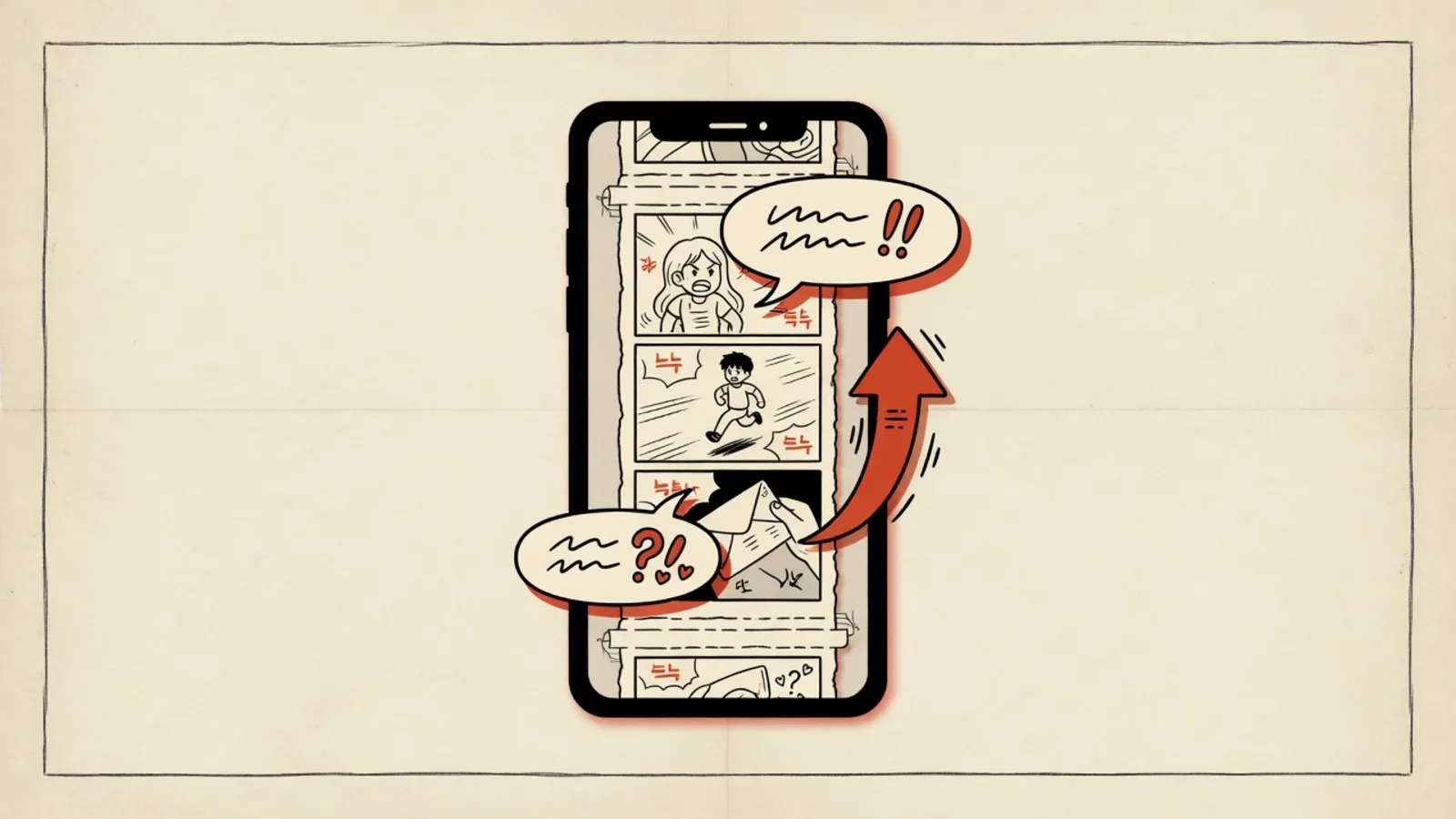
Vertical-scroll comics change OCR, bubble layout, and reading rhythm. Here's what breaks—and what a 2026 pipeline needs for manhwa/manhua.
If you read Korean manhwa or Chinese manhua, you've been there. You finally track down the raw version of that series everyone's talking about—open it up, and it's a wall of Hangul scrolling vertically across your screen. You screenshot a panel, toss it into Papago or Google Translate, and the result is a mess: dialogue floating outside bubbles, vertical sound effects torn apart into gibberish, fonts that look like a ransom note. One page? Survivable. A full chapter? You close the tab and hope someone scanlates it eventually.
The problem isn't that AI translation isn't good enough. It's that almost every "AI manga translator" on the market was built for a completely different format: Japanese manga—paged, scanned, left-to-right (or right-to-left) panels. Webtoons, manhwa, and manhua are an entirely different species: vertical, long-strip, mobile-first, with dialogue bubbles scattered across thousands of pixels of vertical real estate.
Using a Japanese manga translation tool on a Korean webtoon is like using PDF software to layout an Instagram story carousel. The logic doesn't map.
This article is based on a dedicated research report on manhwa and manhua translation workflows. We're going to map out exactly where vertical-scroll translation goes wrong—and why AI Manga Translator is the tool I'd recommend for this format in 2026.
Vertical-Scroll Comics and Paged Comics Are Not the Same Medium
Before we even talk about which OCR engine is best, let's address the format gap. If you skip this, every technical decision downstream is misaligned.
WEBTOON's official creator guidelines spell it out: creators upload ultra-long vertical images, and the platform auto-optimizes them by slicing into individual images capped at 800×1280 pixels. Meanwhile, Amazon KDP's comic guidelines describe a fixed-layout world of single pages, facing pages, and panel-by-panel Guided View navigation. The implications are profound:
- For vertical webtoons, the minimum processing unit isn't a "page"—it's a local scroll segment or a text region.
- For paged comics, the minimum unit remains the page, the panel, or the grid.
This isn't just a technicality. It changes how narrative rhythm works. Traditional manga uses page grids and page-turns to build timing and tension. Webtoons use vertical whitespace, scroll distance, and delayed reveals to create pacing. Academic research also points out that webtoons can layer in sound effects, music, animation, and interactive elements—making them closer to a multimedia experience than a static printed page.
Translation in this context isn't just "replace the dialogue." You're also protecting scroll rhythm, preserving whitespace pacing, maintaining emotional pauses, and handling text that may be spatially tied to sound cues.
The three most common failure modes when people apply manga translation pipelines to webtoons:
- Dumping the entire long-strip image into OCR at once: the detector misses small text or misidentifies distant white space as text-free regions.
- Treating bubble replacement as "fill in the box": font sizes oscillate wildly across the vertical scroll, destroying mobile readability.
- Translating only dialogue and ignoring sound effects, embedded text, and environmental text: readers get the plot but the visual experience feels half-finished.
These aren't translation quality issues. They're systemic failures caused by format mismatch.
Korean OCR: "Supports Korean" ≠ Handles Manhwa Speech Bubbles
This is probably the single biggest misconception in the market right now.
Korean OCR isn't hard just because of image noise. Hangul is a syllabic block writing system—the total number of legally valid Hangul syllables is 11,172. Compare that to English (26 letters) or Japanese kana (~100 characters), and you're in a completely different order of magnitude. Academic research shows that whole-syllable classification suffers from severe class imbalance, while grapheme-level modeling significantly mitigates the problem.
But here's the bigger issue: there are virtually no publicly available, standardized benchmark datasets specifically for Korean webtoon/manhwa speech bubble OCR. The evidence we have comes from three indirect sources: Korean scene text benchmarks, Korean receipt/document benchmarks, and general (mostly Western/Japanese) comic OCR research.
Here's what the publicly available numbers actually show:
| Task | System | Char/Word Accuracy | Notes |
|---|---|---|---|
| Korean scene text | Tesseract | 13.0 / 11.5 | Traditional OCR; weak on Korean in-the-wild text |
| Korean scene text | EasyOCR | 71.9 / 55.5 | Deep OCR significantly better than Tesseract |
| Korean scene text | Grapheme-based OCR | 96.1 / 89.4 | Specifically designed for Hangul class imbalance |
| Korean receipts | PaddleOCR | CER 15.84% | Lowest error rate on 2026 KORIE benchmark |
| Comic OCR pipeline | FCENet + MASTER | Word acc. 0.13→0.40 | Detection is the bottleneck, not recognition |
Here's the critical takeaway: not a single tool vendor has published webtoon/manhwa-specific accuracy numbers. Google Vision, Azure, CLOVA OCR, PaddleOCR, EasyOCR—they all say "supports Korean." But "supports Korean" and "reliably extracts dialogue from speech bubbles in a vertical-scroll webtoon" are separated by at least one full round of project-specific validation.
So the next time someone tells you "this OCR supports Korean, so it's great for manhwa translation"—assume it's an unverified claim until proven otherwise. It's not necessarily wrong. It's just untested.
Korean → English/Chinese Translation: Papago, Google, or DeepL?
The translation engine question has a clearer answer than the OCR question: use commercial cloud APIs for the draft, glossary constraints for consistency, and human post-editing for quality.
The big three shake out like this:
| Solution | Core Strength | Glossary Support | Best For |
|---|---|---|---|
| NAVER Papago | Native Korean-language affinity; image translation support | Yes | Manhwa-first projects; should be in your A/B test |
| Google Cloud Translation | Scalable, stable; first 500K chars/month free | Yes (glossary) | High-volume, cloud-native, cost-trackable |
| DeepL API | Mature terminology control; strong data security | Yes (glossary) | High-value chapters, terminology-sensitive content |
| OPUS-MT | Free, local deployment | Must build yourself | Intranet, air-gapped, low-budget |
| LLM + Terminology Constraints | Strong context awareness | Via prompt injection | Character voice, long dialogue, post-editing polish |
For manhwa projects specifically, Papago deserves to be in your first round of A/B testing—its understanding of Korean-language context has a natural edge. Google wins on scale and integration. DeepL wins on style control and data governance. Open-source options like OPUS-MT are free but come with a real caveat: direct ko→en or ko→zh model availability is spotty, and many real-world implementations end up pivoting through English, which degrades quality.
One thing that's easy to overlook: your glossary is not supplementary material. It is a primary production asset. At minimum, it should include: character names, honorific systems, organization/faction names, ability/skill names, catchphrases, sound effect mappings, and do-not-translate terms. Google, DeepL, and Papago all support glossaries—there's no excuse not to use them.
Simplified vs. Traditional Chinese: Where OpenCC Actually Belongs
A lot of projects mess this up in one of two ways: either treating simplified and traditional Chinese as interchangeable ("they're the same, who cares") or assuming a one-click conversion solves everything ("just run OpenCC and ship it").
OpenCC describes itself accurately: it's a Chinese conversion engine, not a translator. It handles things like 汉字→漢字, 鼠标→滑鼠, 数据库连接池→資料庫連線池—regional vocabulary and character-form conversions. It does not do language translation.
The pragmatic approach for most projects:
- Mainland China is your primary market → produce a zh-Hans master script first, then use OpenCC for s2t/s2tw/s2hk derivations. Manually maintain an exception table for character names, internet slang, place names, and onomatopoeia.
- Taiwan/Hong Kong is your primary market, and localization nuance really matters → produce a zh-Hant script directly, then refine regional vocabulary. Don't derive from simplified.
OpenCC is a fantastic tool, but don't expect it to handle everything. For localization-heavy elements—character voice, internet memes, culturally specific jokes—human intervention isn't optional.
Typesetting: What Separates "Scanlation Quality" from "Obvious AI Editing"
The final quality of a comic translation almost never dies at the translation stage. It dies at image text replacement.
The priority order for speech bubble replacement should be: preserve the original bubble silhouette and visual weight > fit the translation inside > pursue word-for-word fidelity.
Chinese text is often denser than Korean, but character names, interjections, drawn-out speech, and sound effects can go the other way and become longer. So you need to allow for syntactic compression and line-count management without losing information—otherwise, auto-typesetting will cram what were originally light, airy dialogue bubbles into cramped mobile-tiny text. This isn't an aesthetic preference. It's a hard metric that directly impacts completion rates in vertical-scroll mobile reading.
Tools that actually matter for the vertical-scroll comic workflow:
| Tool | Type | Vertical Webtoon | OCR | MT | Batch | Standout Feature |
|---|---|---|---|---|---|---|
| BallonsTranslator | Open-source desktop | ✅ | ✅ | ✅ | ✅ | Explicitly supports extreme aspect-ratio webtoons; mask editing & inpainting |
| comic-translate | Open-source desktop/extension | ✅ | ✅ | ✅ | ✅ | Explicitly lists manga, manhwa, manhua, webtoons support |
| manga-image-translator | Open-source CLI/Web | Partial | ✅ | ✅ | ✅ | Feature-rich but primarily Japanese-manga-oriented |
| Torii | Commercial online | ✅ | ✅ | ✅ | ✅ | Manhwa/webtoon support; browser extension available |
| AI Manga Translator | Commercial online | ✅ | ✅ | ✅ | ✅ | Upload-and-done; cleanest end-to-end experience |
Where AI Manga Translator Fits in the Vertical Translation Landscape
After all that technical context, let's zoom back to the practical question: is there a tool where you don't have to think about OCR engine selection, translation backend switching, or typesetting engineering—where you just drag in a raw manhwa file and get back a readable translated version?
AI Manga Translator is the closest thing to that experience right now.
Its core advantage is this: it takes the complete vertical-scroll translation pipeline—long-strip processing → text region detection → OCR → translation → text erasure and inpainting → typesetting—and packages it into an upload-and-done experience. You don't need to write slicing scripts. You don't need to A/B test three OCR engines on CER. You don't need to worry about translated text overflowing speech bubbles. All of that engineering is handled behind the scenes.
AI Manga Translator's multi-engine backend flexibly handles different language pairs: Korean → English/Chinese translation quality approaches human-edited levels, vertical Japanese text and simplified/traditional Chinese conversion are all supported. New users get 10 free credits to start—enough to translate a full chapter and see the actual output quality. Pricing is usage-based: you pay for what you translate, not for features you might never use.
And the most important thing: for vertical-scroll webtoons specifically, AI Manga Translator's bubble detection and typesetting produce the cleanest results I've seen in the consumer space. The integration between translated text and original artwork is natural—not that cheap "floating overlay" look, but approaching genuine "this was always the localized version" production quality.
If I Had to Recommend One Workflow
If you're looking for the sweet spot between quality, efficiency, and cost, here's the pipeline I'd recommend:
- Keep the original long-strip image. Don't use platform-compressed slices as your master.
- Use AI Manga Translator as your primary translation engine—upload raw files, get back auto-completed OCR + translation + typesetting.
- Frontload glossary management—build your character names, honorifics, skill names, and catchphrases in the first chapter. Reuse for every subsequent chapter.
- Default to simplified Chinese master + OpenCC-derived traditional Chinese, unless your primary market is Taiwan/Hong Kong—in which case, produce traditional Chinese directly.
- Human QA is non-negotiable—at minimum, spot-check terminology consistency, bubble overflow, and plot logic.
For most teams, the real bottleneck isn't translation. It's typesetting and QA. If you spend all your time hunting for the "best MT engine," you're probably optimizing the wrong variable.
A Note on Copyright
Copyright isn't a gray area here. Under the Berne Convention—the foundational international copyright treaty administered by WIPO—translation rights and adaptation rights are explicitly reserved to the original author. Translation, bubble modification, and re-typesetting of a comic may all fall under derivative works. (See WIPO's summary of the Berne Convention and the U.S. Copyright Office's guidance on derivative works.) Publishing without authorization isn't a "debatable gray zone"—it's close to the line by definition.
If you're publicly sharing machine-translated results without thorough review by an experienced human translator, clearly label it as machine translation. When character names, tone, or plot foreshadowing get mangled, readers will blame "bad scanlation"—not the model.
Try it with that manhwa series you've been dying to read—AI Manga Translator gives new users 10 free credits, enough to translate a full chapter and judge the results for yourself.
This article is based on a dedicated research report on manhwa and manhua translation tools and workflows conducted in July 2026. Sources include official tool documentation, academic benchmarks (Hangul OCR, KORIE, COMICS Text+, etc.), WEBTOON official creator guidelines, and publicly available technical reports. All conclusions represent the author's independent assessment based on publicly available information.