Localization
Manga Globalization: When You're Localizing Into 5 Languages, Translation Isn't the Bottleneck
Updated 2026-07-30
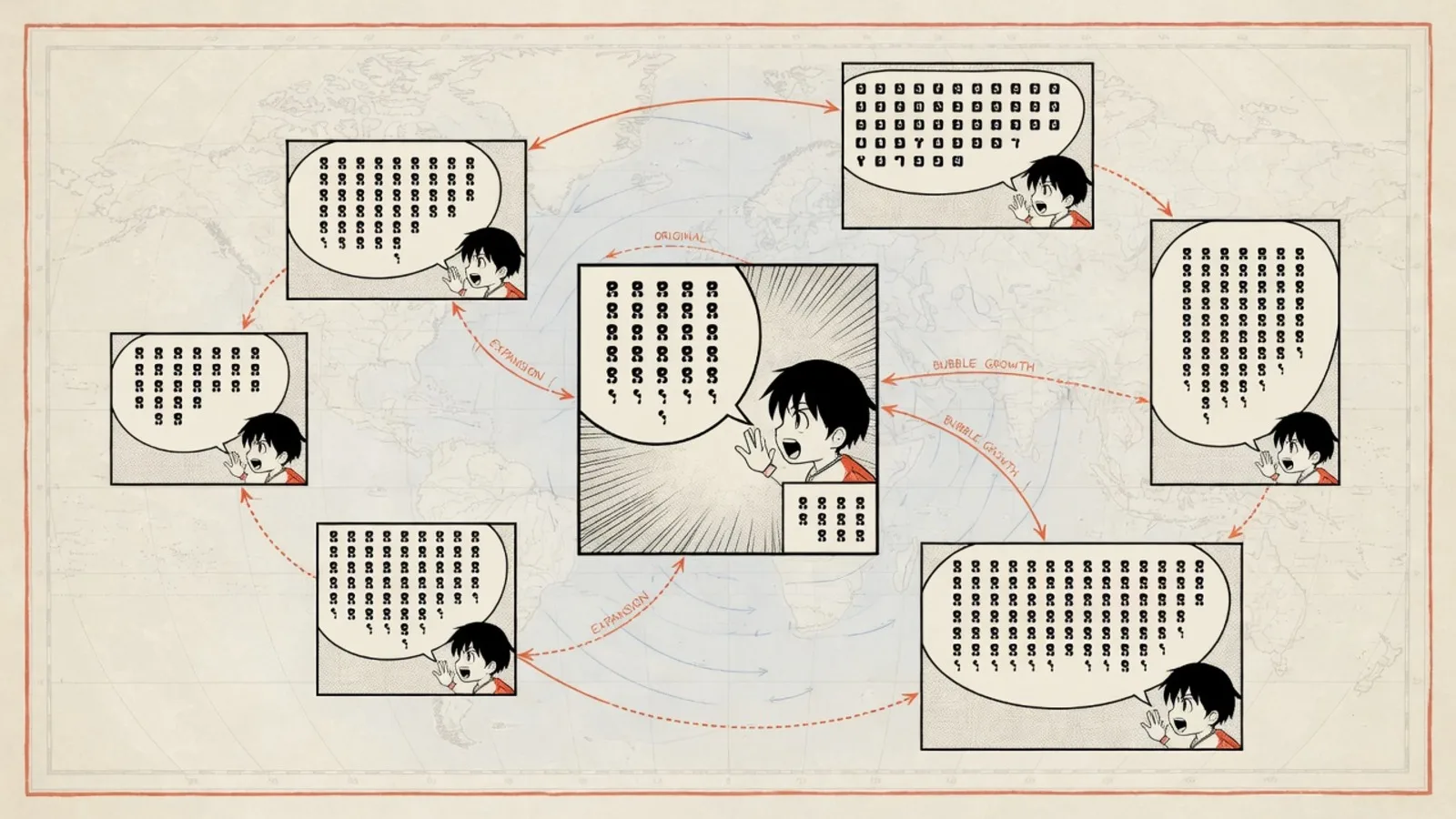
Text expansion, fonts, glossaries, and storefront compliance—the real bottlenecks when shipping manga into multiple languages at once.
Picture this: you've got a Japanese manga series, and you need to ship English, Simplified Chinese, Traditional Chinese, Spanish, and French editions—all in parallel. If you think translation is the part that'll eat your schedule, you're about to be surprised.
AI can crank through raw translation fast enough these days. What actually stops you is bubble real estate running out, fonts missing accent marks in Spanish, French text expanding 70% beyond the original Japanese, and terminology drifting apart across five language tracks.
That's the core reality of manga multi-language localization. It's not "translate Japanese into five languages." It's "fit five writing systems into one set of speech bubbles while preserving layout, reading rhythm, and character voice."
This article draws on a systematic research report on manga multi-language localization, unpacking the most underestimated parts of the pipeline and showing where AI and automation can actually save you time.
Swap the Language, Break the Bubble—Text Expansion Is Layout Enemy #1
There's an open rule in the localization industry: switching languages doesn't preserve character count.
Publicly available data shows Japanese-to-English translation typically expands by 20% to 60%. English into French or Spanish often adds another 15%–25% on top of that. Net result: Japanese → French can expand 35%–70%, and Japanese → Spanish can expand 40%–75%.
These aren't numbers you memorize. They're red lines you draw before typesetting starts.
Imagine a tall, narrow vertical bubble in the original Japanese. The text fits easily in vertical orientation, with breathing room. Now swap in French. Articles, inflectional endings, accent marks, and horizontal text structure all pile in at once—and the bubble overflows.
Simplified and Traditional Chinese take a different path. They share the CJK writing system with Japanese, meaning character density is high and text expansion is far less dramatic. Simplified Chinese typically stays within 0% to 10% expansion; Traditional Chinese hovers around 5% to 15%. But the problem just changes shape: Traditional characters, with their greater stroke complexity, feel darker and more cramped in small bubbles, creating visual pressure the Japanese original didn't have.
W3C and IBM's internationalization experience carries one especially critical warning: the shorter the string, the more dramatic the expansion. Manga dialogue is packed with short utterances, shouted lines, verbal tics, and sound effects—every single one of them sits squarely in that high-risk zone.
So in practice, smart teams don't memorize percentages. They assign a "crowding grade" to every bubble:
| Target Language | Plan for This Expansion | At >115% Fill | At >130% Fill |
|---|---|---|---|
| English | +20% to +60% | Rephrase and rebreak lines first | Consider rewriting or local bubble expansion |
| French | +35% to +70% | Prioritize synonymous compression | Don't just shrink the font and cram it in |
| Spanish | +40% to +75% | Keep the tone, favor shorter words | If you're past 4–5 lines, rewrite |
| Simplified Chinese | Under +10% | Adjust line distribution and punctuation compression | — |
| Traditional Chinese | +5% to +15% | Use open Pan-CJK fonts; add extra internal padding | — |
These thresholds aren't an industry standard. They're production guidance derived from expansion ranges and manga readability constraints. The core logic: the primary goal of typesetting isn't "fit all the words in." It's preserving the original's reading rhythm and eye flow. Academic research confirms that average panel viewing time scales proportionally with bubble text length—stuffing a glance-and-go line into dense micro-type destroys the pacing.
Font Strategy: English, French, and Chinese Need Different Families
One of the most common mistakes in manga localization is thinking you can find one "manga-looking" font and use it for every language.
Here's the problem: English manga dialogue often uses all-caps hand-lettered fonts, with dedicated comic font foundries like Blambot and Comicraft offering mature, stylistically cohesive options. But port that logic to French or Spanish, and accent marks (é, è, ê), inverted question marks (¿), and inverted exclamation marks (¡) start breaking. Blambot's Anime Ace 2 page explicitly states it has "limited European characters"—meaning it works for English, but shouldn't be your default dialogue font for French or Spanish projects.
As for Simplified and Traditional Chinese, they're structurally incompatible with English comic fonts. Chinese relies on character face size, weight balance, and intra-line breathing room to build reading comfort—a completely different aesthetic logic from the all-caps, hand-textured feel of English comic lettering.
The research report recommends this font framework:
| Target Language | Recommended Dialogue Fonts | Safety Net System Fonts | Key Warning |
|---|---|---|---|
| English | Blambot / Comicraft comic fonts | Comic Neue, Bangers (open-source fallback) | Verify commercial license scope |
| French | Clean sans-serif with full Latin Extended | Source Sans 3, Noto Sans | Don't default to all-caps English comic style |
| Spanish | Same as above; verify ¿/¡ support | Noto Sans, Source Sans 3 | Spanish expands more; don't sacrifice readability for style |
| Simplified Chinese | Open Pan-CJK sans-serif | Source Han Sans, Noto Sans SC | Face size, weight, and embedding rights matter most |
| Traditional Chinese | Same as above; watch detail crowding | Source Han Sans, Noto Sans TC | In small bubbles, cut words before compressing tracking |
Here's a safety-net strategy that works for virtually every project: build a two-tier font system. The bottom tier is Google Noto / Adobe Source Han—open-source families with massive coverage and clear licensing under the SIL Open Font License. They guarantee no character will ever break. The top tier is your project style fonts, used only for specific layers: dialogue, SFX, titles. This separates "does it look good?" from "will it crash?"
One note on vertical text: unless you're doing a collector's edition, don't preserve vertical typesetting across target-language editions. Japanese originals are routinely vertical, but English, French, and Spanish almost always go horizontal in international publishing. Simplified and Traditional Chinese can technically go vertical, but horizontal is far more stable across fixed-layout EPUB, Kindle, and web environments.
Running Five Editions in Parallel? Terminology Drift Is Your Biggest Hidden Threat
You've probably had this reading experience: the English edition calls the protagonist "Hiroshi." The French edition says "Hiroshi-san." The Spanish edition has "Señor Hiroshi." And the Traditional Chinese edition just goes with "宏." Worse, the hero's signature move has four different names across five languages.
This is what a multi-language project looks like when character names, honorifics, attack names, organization names, and verbal tics aren't managed as terminology assets.
The research report puts it well: build your glossary before your translation memory. TM handles "segment reuse"—pushing common lines like "nice weather today" to translators automatically. But the glossary manages "identity consistency"—what the protagonist is called, how honorifics are handled, how signature moves are written. For manga, the latter's failure is far more damaging than the former.
Compare the two approaches:
| Management Approach | Name Consistency | Cross-Language Collaboration | Publishing Risk |
|---|---|---|---|
| Translators winging it | ❌ Everyone translates differently | ❌ Five languages working in silos | 🔴 High: Readers spot the inconsistencies |
| Shared glossary + TM | ✅ Key terms locked | ✅ Cross-language sync alerts | 🟢 Low: Glossary centrally maintained |
Professional CAT tools (memoQ, Trados) and cloud TMS platforms (Smartcat, Crowdin, XTM) all offer terminology management and translation memory reuse. But making these tools actually serve manga production depends less on which software you open and more on how you structure your script fields.
The most practical approach is extracting every bubble into a structured text block with these fields:
- page_id / panel_id / bubble_id: Shift the translation unit from "sentence" to "sentence in context of the artwork"
- speaker: Who's talking—solves elided subjects and character speech quirks
- scene_id: Enables context linking. (Research shows that including the previous scene significantly improves translation quality, but piling on more scenes past that actually degrades it.)
- text_type: dialogue / narration / sign / SFX / caption—each type demands a different translation strategy
- length_risk: Green/Yellow/Red tier warning—surface layout problems at the translation stage, not when the letterer is already at the finish line
The underlying logic is simple: automation handles the repetitive, mechanical, verifiable parts (OCR, region detection, file batching, script import/export, overflow checking), while the hardest-to-automate and highest-impact parts (reading order, tonal compression, SFX visual style, local redrawing) stay human.
AI Manga Translator: An Accelerator for Multi-Language Manga Localization
By now, the picture should be clear: the bottleneck in manga multi-language localization isn't translation speed. It's the combined efficiency of expansion management, font strategy, terminology consistency, and layout adaptation.
That's exactly the product logic behind AI Manga Translator.
Its workflow: OCR extracts manga text → machine translation (multi-language support) → preserves bubbles and layout → inpaints → exports. For multi-language projects, this means you don't redo the entire "text removal → typesetting → lettering" pipeline for each language. AI Manga Translator handles text extraction and bubble preservation at the base layer, letting you switch between target language outputs and dramatically cutting down repetitive layout adjustment work.
For multi-language scenarios specifically, several key capabilities stand out:
- Automatic bubble detection and preservation: Bubble positions and shapes are locked during OCR, so translated text automatically adapts to the original bubble space during inpainting. For expansion-heavy English/French/Spanish editions, you can at least immediately see which bubbles won't fit—rather than discovering it only after the letterer receives the artwork.
- Multi-language translation engine: Supports English, Chinese, Spanish, French, and other major target languages. For repetitive dialogue (battle shouts, background signage) and descriptive text, AI delivers fast first drafts, leaving human editors to handle style and tone at the final review stage.
- Reading flow preservation: The entire pipeline—from detection to inpainting—is designed around the premise that bubbles stay put and reading order doesn't change. This ensures the panel's eye flow won't break just because the language switched.
Of course, research and industry practice both consistently validate the same conclusion: AI is best for preprocessing and risk screening, not for final quality assurance. Machine translation works best in manga for repetitive dialogue, background explanations, signage, recap narration, and large-backlog long-running series maintenance. It works worst for punchlines, puns, establishing a character's voice for the first time, honorific conflicts, climactic romance/action lines, and any SFX where word and image are fused together.
So the best practice for multi-language projects is: use AI Manga Translator for batch first-pass translation and layout preprocessing, and focus human editors' energy on the parts that actually demand judgment—style decisions, terminology sign-off, SFX visual strategy, and cross-language consistency review.
Before You Hit Publish, Don't Skip These
A few operational realities that multi-language publishing can't afford to ignore.
Copyright contracts must explicitly cover translation rights, adaptation rights (including redrawing/SFX regeneration), digital font embedding, fixed-layout EPUB/Kindle distribution, territorial and language scope, and review/approval rights. Under the Berne Convention, as summarized by WIPO, both translation and adaptation fall within the exclusive rights of the copyright holder. If your contract doesn't explicitly authorize redraws, SFX regeneration, and font embedding in EPUB/PDF/Kindle files, no amount of beautiful lettering will save you from legal exposure. (See WIPO's overview of the Berne Convention.)
Platform compliance can't be handled in the abstract. Amazon KDP has specific technical requirements for manga fixed-layout and Guided View functionality. Apple Books mandates complete, non-placeholder submissions. Google Play Books and Kobo each enforce their own content policies. Multi-language, multi-platform distribution means every edition on every storefront needs individual clearance. The safest approach is to build a storefront checklist covering nudity, violence involving minors, hate speech, metadata accuracy, sample chapters, and embedded font licensing—and check every item for every edition. Under US law, platforms are also subject to Section 230 of the Communications Decency Act (47 U.S.C. § 230), which provides limited immunity for user-generated content but does not shield publishers from liability for content they produce or commission directly.
SFX strategy must be locked down at project kickoff. You've got three options: full redraw, retain original with stylized subtitle overlay, or simple plain subtitle treatment. No option is inherently better—it depends on market expectations, budget, and timeline. But there is one iron rule: don't mix strategies within a single volume. One page redrawn, the next annotated, the next left untouched—that kind of inconsistency kills reader immersion faster than any imperfect translation.
The Bottom Line
The real barrier in manga multi-language localization isn't "can we translate it?" It's "can we read it after translation? Does the character still sound like the same person? Are readers across five languages actually getting the same work?"
Most of the time in this pipeline shouldn't go to translation. It should go to: identifying which bubbles will overflow before typesetting starts, picking the right font for each language, locking character names and signature moves into a glossary, and raising layout warnings at the translation stage—not when the letterer is already deep in cleanup.
AI Manga Translator offers 10 free credits for new users, with a Basic subscription at $10/month (annual billing). If your project needs to reach multiple language markets simultaneously, it compresses the most labor-intensive part of the pipeline—translation plus layout preprocessing—into a manageable scope, so you and your team can focus your energy where human judgment actually makes the difference.
This article is based on a systematic research report on manga multi-language localization, drawing on SWET professional manga lettering/typesetting practitioner interviews, WIPO copyright and translation rights materials, W3C internationalization and text expansion data, Adobe publishing and typography documentation, Amazon KDP, Apple Books, and Google Play Books fixed-layout and content policy documentation, and ACL/AAAI academic conference papers on manga translation and context effects. For those interested in the legal framework governing cross-border publishing and automated content production, see the European Commission's AI Act overview for the regulatory landscape on AI-assisted content, and WIPO's Copyright Treaty overview for international copyright frameworks relevant to digital distribution. All conclusions represent the author's independent assessment based on publicly available information.