Education
Learning a Language Through Manga: Is AI Translation a Study Partner or a Shortcut That Backfires?
Updated 2026-07-31
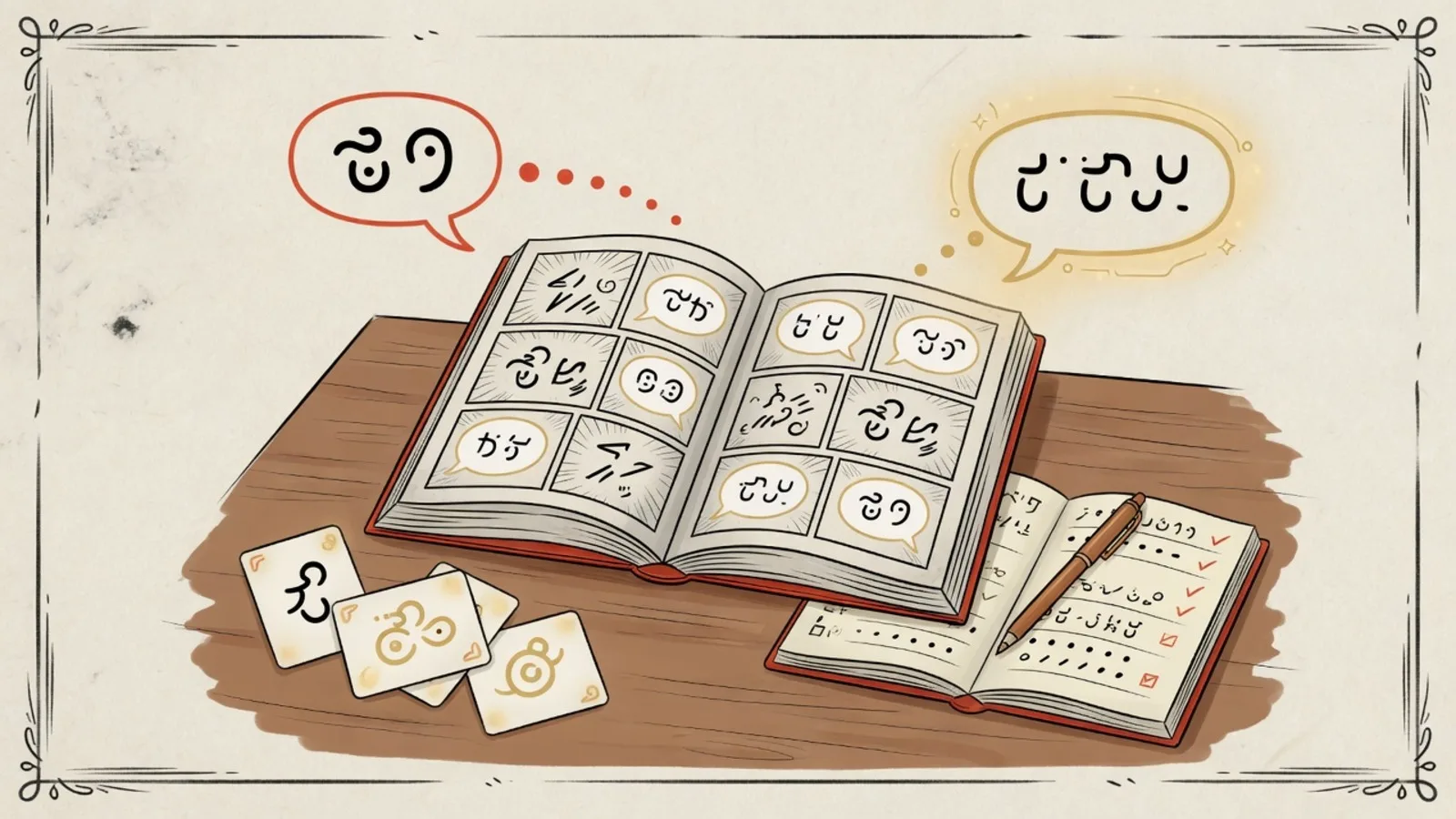
How to use AI manga translation as a study aid without killing the learning loop—stepwise protocols for beginners to intermediate readers.
You've been there. You pick up a manga in your target language, powered through a dozen pages connecting dialogue to artwork, and then realized—you remember the protagonist's name and absolutely nothing else.
But maybe you've also had the opposite experience. That one line, anchored to a character's expression, a gesture, the tension of a scene—it just clicked. It stuck with you longer than any flashcard ever did.
That's the magic of manga for language learning. It doesn't hand you vocabulary in isolation. It embeds language inside a living story.
Now here's the question that matters: when AI translation enters the picture, does that magic survive?
What the Research Actually Says About Manga and Language Learning
Let's skip the fluff. Manga has genuine methodological value in second language acquisition. This isn't marketing—it's backed by a real body of research.
The consensus in language acquisition theory rests on two pillars: input needs to be comprehensible and contextualized. Memorizing vocabulary lists fails because it delivers neither. Manga delivers both by default. You're not decoding a standalone sentence like "I barely made it." You're watching a character, drenched in sweat, gripping a doorframe, saying those exact words. The visual narrative provides the scaffolding.
Multimodal learning research reinforces this. Eye-tracking studies have shown that readers who actively leverage visual information tend to achieve better comprehension. Readers who fixate exclusively on text, surprisingly, don't always understand more. It's intuitive: when you see the sweat, the exhaustion, the body language—you feel what "barely" means before you ever look it up.
The empirical evidence, while not vast, points in a positive direction. One study found that after 20 instructional sessions using manga-based reading materials, the experimental group outperformed a control group using standard text-and-image materials on reading comprehension. Another study on the graphic novel adaptation of Macbeth reported significant effects on literary comprehension, inferencing, vocabulary, and reading motivation.
There's also a dimension that matters especially for learners who find traditional study anxiety-inducing: manga lowers the stakes. You're not staring down a wall of dense text. A single panel rarely holds more than a couple of lines. That "low-risk" reading experience gets people who normally avoid reading in their target language to actually sit down and engage.
But here's the part nobody puts in the marketing copy: manga isn't a silver bullet. Its strengths are clear—lowering the entry barrier, building reading motivation, exercising contextual inference. Systematic writing instruction and grammatical precision? Not its strong suit. If your goal is a perfect TOEFL writing score, manga is a supplement, not a solution.
Then AI Translation Showed Up—and Complicated Everything
Let's do the good news first: AI translation in the manga learning context works. It works well.
Meta-analyses and systematic reviews on machine translation in language learning converge on a broadly positive assessment. At the level of "getting the meaning," modern neural machine translation is already remarkably capable. For beginners, AI-powered glossing dramatically reduces the comprehension barrier—you don't need to pause every three panels to thumb through a dictionary. An entire manga page can be processed in minutes instead of an hour.
This is exactly where tools like AI Manga Translator shine: they drive the cost of "understanding what's happening" down to almost zero.
But that's also precisely the problem.
The research is unanimous on one caution: comprehension is not the same thing as acquisition. When you read "Barely. The bus broke down again." and immediately glance at a polished translation—"Barely made it. The bus broke down again."—your brain registers the meaning. But it has just skipped every cognitive step that matters for learning: guessing, checking, verifying, encoding.
Classroom studies have repeatedly demonstrated that when learners are given unrestricted access to full translations, they circumvent the "hypothesize → test → produce → correct" cycle entirely. Dependency forms. This isn't AI's fault—it's how human brains conserve energy. Why take the stairs when there's an escalator?
The finding, then, is this: AI translation in manga-based learning can be either your best scaffold or your most convenient substitute. The difference isn't the tool—it's the protocol.
How to Use AI Translation Without Sabotaging Yourself: The Three-Tier Approach
Based on the current research and best practices drawn from both SLA theory and machine translation pedagogy, the optimal approach is straightforward: don't reveal the full translation first.
That's it. Three words: don't go first.
Here's a concrete framework I'll call the Three-Tier Approach:
Tier One: Image first, then original text.
This is the non-negotiable step. The artwork itself has already handed you an enormous amount of information—facial expressions, action vectors, environmental cues. Scan the panel visually. Form a hypothesis about what's happening. Then read the original text. At this stage: no dictionary, no translation, no AI. Use whatever vocabulary you already possess and push through.
You'll be surprised how much you already understood.
Tier Two: Key-word lookups only.
If a line genuinely blocks you, look up only the one or two words that are causing the stall—not the entire sentence. For "Barely. The bus broke down again."—the art shows you an exhausted character who clearly almost didn't make it. You've already inferred the gist. You just need to confirm "barely" and "broke down."
This word-level lookup is actually inference verification in disguise. Was your guess correct? That verification loop alone creates deeper memory traces than passive translation consumption ever will.
Tier Three: Full translation, but only as the last resort—and always followed by output.
If, after the artwork and the key-word lookups, you're still genuinely lost—now you can look at the full translation. But there's a mandatory discipline: immediately follow the translation with a production task.
Paraphrase the line in your target language. Rewrite it in your own words. Or flip the exercise: if you had to convey the same meaning in the target language, how would you say it?
This isn't pedantry. This is Swain's Output Hypothesis in action: input alone is insufficient. Learners need to expose gaps in their own interlanguage through speaking, writing, paraphrasing, and reformulation. Translation that ends with passive reading is consumption. Translation that ends with production is learning.
AI Manga Translator: What It Gets Right
Let's talk about an actual tool: AI Manga Translator.
First, an honest assessment of the landscape. There aren't many tools today that genuinely integrate "manga translation" with "language learning design." Most products solve the comprehension problem—generic image translators, standard OCR pipelines—but have essentially zero learning-oriented design in their interaction model.
What makes AI Manga Translator interesting is how its workflow naturally supports stepwise engagement:
- Upload a manga page — you choose the content that interests you
- Automatic OCR — text is extracted from speech bubbles
- Bubble and layout preservation — the translation is embedded back into the original artwork, keeping the visual rhythm intact
The third step is the crucial one. The translated text lives inside the original page, not in a separate plain-text panel. You're still looking at the artwork, the paneling, the expressions, the visual storytelling. The translation bridges the language gap without dismantling the reading experience.
This aligns naturally with the Three-Tier Approach. You can read the artwork and original text first, glance at the translation only when you're stuck, and immediately return to the story without context-switching.
Pricing is reasonable: new users get 10 free credits to test the waters. Subscription plans range from Basic ($10/month billed annually) to Ultra ($53.25/month), scaling with your reading volume.
Honestly, for manga-based language learners, the real value proposition here isn't "translation accuracy"—most modern AI translation engines perform comparably at this point. It's that the tool's interaction design, intentionally or not, keeps you in the rhythm of "original first, translation second."
Different Levels, Different Protocols
"Manga for language learning" is not one activity. The right approach depends entirely on where you are.
Beginner Learners
You're at the stage where everything looks intimidating, and the urge to quit after two pages is real.
Your best move: choose panels where the visual storytelling is strong and the dialogue is sparse. Prioritize pages you can mostly decode through artwork alone. Follow the protocol strictly: scan the visuals → read the original → tap for word-level glosses → full translation only as the safety net of last resort.
Internalize one principle: the full-panel translation is never your default. It's your emergency exit.
Google Translate itself provides instructive design choices here—it defaults to showing the original text alongside the translation and offers "select text" and "listen" functions, rather than just covering everything with an opaque translated layer. Good learning tools should be even more deliberate about this: assistance should be deferred, not preemptive.
Intermediate Learners
You can read a fair portion of the original text now. Your actual needs are: quick lookups for unfamiliar words, a system to capture and review those words, and a reading flow that isn't constantly interrupted by dictionary consultations.
With AI Manga Translator at this stage, the right habit is: use translation as a spot-check tool. Only peek at the translation for specific words or lines that genuinely block you. Everything else you can read on your own—leave it untranslated.
Then take one extra step: jot down the new vocabulary from that session. "Barely." "Broke down." "Made it." Three phrases. Write them down after reading. Glance at them the next day. This tiny habit, applied consistently, outperforms hour-long cramming sessions.
Advanced Learners
At this point, comprehension isn't the bottleneck. What's worth training is tone, register, cultural nuance, and pragmatic judgment.
For advanced learners, AI translation's best role isn't "answer key"—it's comparison material. Try exercises like:
- Compare the official translation of a line with the AI's version. Where does the tone diverge?
- What cultural references or subtext did the AI miss?
- If you had to rewrite the line in a different register—angry, teasing, gentle—how would you do it? Then have the AI generate its own version and compare.
This is AI translation at its highest-leverage use case: generating contrastive samples so your own linguistic sensitivity sharpens through comparison.
A Concrete Example
Let's revisit that scene.
A single panel. Character A, greeting a sweat-drenched Character B who's just stumbled through the door: "You made it." B, gasping: "Barely. The bus broke down again."
The wrong way: Tap for the AI translation. Read "You finally made it." "Just barely. The bus broke down again." Swipe to the next page. You understood everything. You learned nothing.
The right way:
Step one: Scan the art. B is sweating, gripping the doorframe, radiating exhaustion and frustration. The visual has already told you: he almost didn't make it, and it wasn't his fault.
Step two: Read the original. Paired with the visual, you can already infer that "barely" means something like "just barely / almost not" and "broke down" involves the bus failing. Your brain is actively inferring. That's the work that creates durable memory.
Step three: Check key vocabulary. If "made it" in this context still feels unfamiliar, look it up—but only that phrase. Not the whole sentence. You're now learning "made it" not from a decontextualized vocabulary list, but from a specific, emotionally charged scene where you needed to know what it meant. That's how deep encoding happens.
Step four: Produce. After the page, say (out loud or in writing) in your target language: "He almost didn't make it because his bus broke down again." It's simple. But you've just completed an active production cycle.
An Honest Closing Note
Before writing this, I reviewed a significant body of research on AI translation in language learning.
The conclusion is more honest than you might expect: nobody can tell you definitively that AI translation in manga learning is "good" or "bad." Not because the AI isn't capable enough. Because the variance in how it's used dwarfs the variance in how good the AI is.
One-tap full-page translation? You'll have a great reading experience and a poor learning outcome.
Tiered, deferred, output-paired use? Slower, yes. But the retention difference is night and day.
Tools like AI Manga Translator derive their real value from making the "slower but effective" protocol feel natural—you're still reading manga, still following the story, still immersed. Translation shows up when you need it, not before you've had your chance to engage.
Learning a language through manga is, at its core, about your relationship with the story. AI translation is the friend who helps you understand it—not the friend who reads it for you.
For learners interested in a complementary approach, Crystal Hunters offers manga deliberately written for language learners, with controlled vocabulary and grammar difficulty. This is a different category entirely: "manga designed as learning content" rather than "AI that translates any manga for you." The two approaches complement each other—one provides structured input, the other unlocks authentic content.
Start with AI Manga Translator — upload a page, choose your language, get translated panels that preserve bubbles and layout. 10 free credits for new users.
Disclaimer: This article references general principles from second language acquisition research and machine translation pedagogy, including findings consistent with the work of Krashen, Swain, Mayer, and others in the field of applied linguistics. Specific tools mentioned are for illustrative purposes and do not constitute endorsement of any particular product's compliance with regulations such as COPPA (Children's Online Privacy Protection Act, 15 U.S.C. §§ 6501–6506), GDPR, or other applicable data protection frameworks. Users should independently verify that any tool they use complies with relevant privacy and data handling laws in their jurisdiction.